



































Main content
How education could strengthen soil-transmitted helminth control in children and communities: lessons from a scoping review, with a focus on India
The Problem
Soil-transmitted helminth (STH) infections remain among the most common infections worldwide, affecting an estimated 1.5 billion people – approximately 24% of the global population. They disproportionately affect impoverished communities with inadequate sanitation. In children, persistent infections can contribute to nutritional impairment, anaemia and impaired physical development, although the relationship between STH infection and cognitive or educational outcomes is more complex and remains an area of continuing research. [1]
The WHO recommends an integrated approach to STH control that combines periodic preventive de-worming medication with health education and improvements in water, sanitation and hygiene (WASH). [1] Deworming reduces the existing worm burden but does not prevent subsequent exposure. If sanitation and hygiene conditions remain unchanged, reinfection can therefore occur, limiting the longer-term impact of treatment alone.
India has one of the world’s largest populations at risk of STH infection. The National Deworming Day (NDD) programme provides biannual albendazole treatment to children and adolescents, aged 1–19 years, through schools and Anganwadi centres. A separate educational programme in India, called the “National School Health and Wellness Programme”, does include education on STH prevention, with an emphasis on the importance of handwashing. However, it suffers from vague implementation guidelines and includes only a few sessions per year, limited to primary school settings. It is also not a required subject in schools, and performance indicators focus only on the number of children receiving albendazole medication rather than behaviour change or STH infection education/knowledge.
The scale of albendazole administration in India highlights the capacity for national health initiatives delivered through schools. However, it could also be successfully supplemented by a structured educational programme and environmental measures to improve sanitation, which would reduce exposure and support sustainable behaviour change, in line with WHO recommendations. [2]
Why education matters
Health education is not a substitute for effective sanitation, safe water, or access to treatment. Its value lies in linking these interventions to the everyday behaviours and social conditions through which STH transmission occurs. Children can acquire infection through contact with contaminated soil, ingestion of infective eggs or, in the case of hookworm, penetration of larvae through the skin. Education with regard to handwashing, safe disposal of faeces, food hygiene, and wearing footwear can therefore contribute to prevention, but people cannot consistently adopt behaviours that are impossible or impractical within their living environment. [1,3]
Evidence from educational interventions is encouraging but remains limited. A review of health-education activities targeting schoolchildren in Southeast Asia identified a range of approaches, including visual and participatory methods, while highlighting considerable variation in intervention design and evaluation. [3] Programmes for STH prevention such as ‘The Magic Glasses’ have proven that structured teaching which is engaging to children is a key factor in their ability to convert factual information into long-term sustainable knowledge, which in turn influences positive behaviour change (such as improved handwashing behaviours).
Another education-focused STH intervention program in Cameroon also reported an association between health education and reduced prevalence of faecal-orally transmitted parasitic infections among schoolchildren. This further highlights the fact that education is likely to translate to behaviour change that reduces transmission among children when implemented effectively. Health education should therefore be considered a key factor in prevention programs. [4] Despite these findings, however, evidence from other settings demonstrates that improvements in knowledge do not necessarily translate directly into reductions in infection, highlighting the importance of intervention context and implementation. [5]
What did the scoping review find?
This scoping review examined published literature concerning the development and implementation of educational interventions for STH control. We systematically searched PubMed, identifying 72 records for initial assessment. Following screening against predefined inclusion and exclusion criteria and a PRISMA-informed process, 26 publications were included.
First, schools provide an important platform for intervention. They offer an established setting where children can receive repeated messages and practise hygiene behaviours, and where teachers and families can become involved. However, school-based approaches alone cannot reach children who are not enrolled in or do not regularly attend school. Community health workers, religious leaders and other trusted local figures may therefore be important for extending interventions beyond the classroom. Evidence from Zanzibar, for example, demonstrates the potential role of local Muslim religious teachers in extending the reach of behavioural interventions for parasitic disease control. [6] Although this study focused on urogenital schistosomiasis rather than STH, the findings illustrate the value of trusted community structures in reaching populations beyond formal education settings
Second, teachers require appropriate training and resources. Effective interventions are unlikely to emerge from simply adding information about STH to an already crowded curriculum. Participatory teacher training, clear and locally relevant messaging, practical teaching resources, and opportunities for teachers to contribute can improve the feasibility and acceptability of programmes. Research comparing educational methods for schistosomiasis prevention has similarly shown the importance of considering how health information is communicated, rather than relying solely on factual information. [7]
Third, treat community knowledge as an asset rather than an obstacle. Interventions should begin by understanding local beliefs, terminology, behaviours, perceived risks and practical barriers. Messages can then integrate scientific explanations with existing knowledge and experience. Materials should be developed in locally appropriate languages and adapted to different cultural and socioeconomic contexts. Community health education has also been identified as a potentially important component of sustainable approaches to neglected infectious diseases, particularly where interventions engage existing community structures.[8]
Finally, behaviour change requires more than knowledge. Regular routines such as supervised handwashing at key times within schools can help transform information into habits. Emotional and social motivators, including humour, pride, disgust or concern for family wellbeing, may also help reinforce collective action. However, such approaches should be culturally appropriate and should avoid stigmatising children or communities living in conditions of inadequate sanitation. Evidence from WASH education interventions suggests that combining education with practical opportunities to engage in hygiene behaviours is often more meaningful than education alone. [5]
From education to an integrated approach in India
These findings support an integrated STH-control model in which education, MDA and WASH interventions reinforce one another rather than operating as separate activities. Figure 1 proposes a framework, informed by the Knowledge-to-Action framework, for adapting this approach to the Indian context.[9]
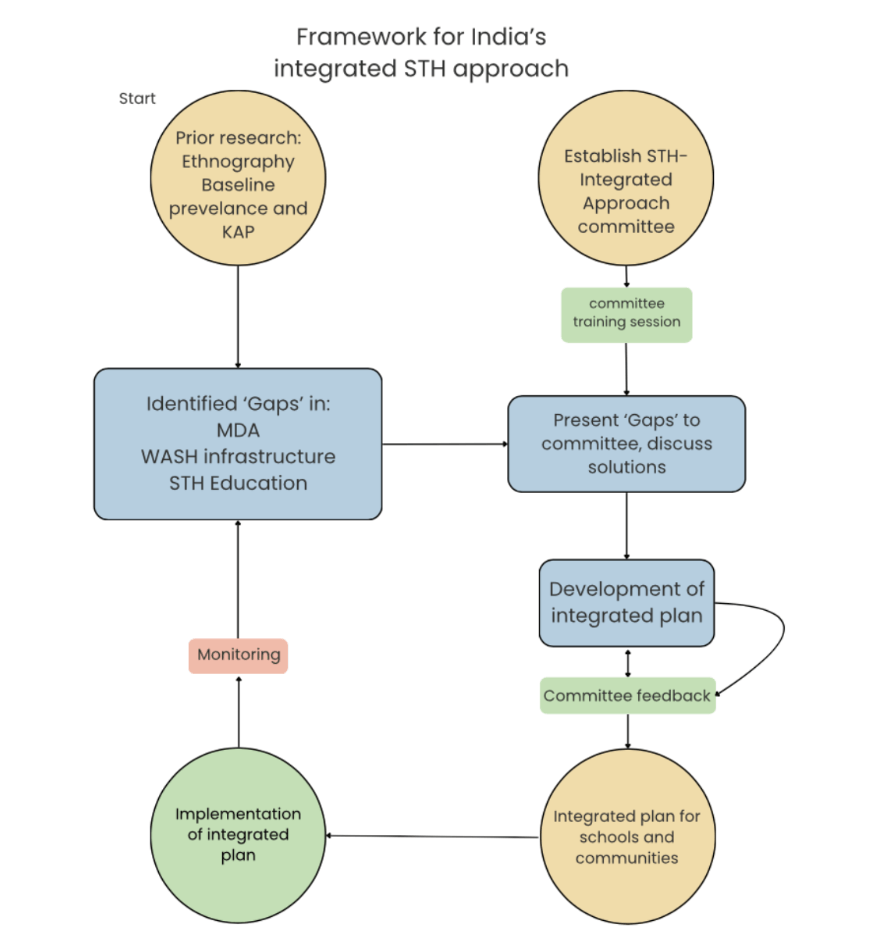
At the national level, it would be preferable to integrate STH education more systematically into existing National Deworming Day-structures rather than create an entirely parallel programme. At the school level, this could include age-appropriate curricula, teacher training, repeated classroom activities and practical hygiene routines. At the community level, Anganwadi workers, Accredited Social Health Activists (ASHAs), local leaders, parents and community committees could support communication and identify barriers to prevention.
Importantly, education should not shift responsibility for STH prevention from institutions to individuals. Telling children to wash their hands or wear shoes has limited value if water, soap, footwear or functioning sanitation facilities are unavailable. Educational interventions should therefore be accompanied by efforts to identify and address structural barriers to prevention.
There are scopes to consider STH through a One Health lens. Human infection is shaped by interactions between people, animals and the environment, particularly where sanitation and waste-management systems are inadequate. Future research should investigate how human, animal and environmental health perspectives can be incorporated into educational interventions without making programmes unnecessarily complex.[8]
| Textbox: Recommendations for future STH programmes in India |
| Based on the findings of this review we suggest the following plausible action points for future STH programmes: 1. Integrating STH education into existing MDA platforms, rather than treating health education as an optional addition. 2. Use repeated, participatory, and age-appropriate educational activities, rather than relying primarily on one-way information provision. 3. Invest in teacher and frontline-worker training, including locally relevant resources and practical guidance. 4. Engage families and wider communities, particularly populations not reached through schools. 5. Co-design interventions with communities, incorporating local languages, beliefs, practices and perceived barriers. 6. Link education to feasible WASH improvements, recognising that knowledge cannot compensate for inadequate infrastructure. 7. Evaluating interventions using behavioural and epidemiological outcomes – including knowledge, practices, reinfection and infection intensity – rather than assuming that improved knowledge automatically produces reduced transmission. 8. Investigate One Health approaches and longer-term sustainability, including whether education can contribute to reducing transmission where treatment is already routinely available. |
Conclusion
STH control cannot be reduced to a choice between treatment and education. MDA remains an important intervention for reducing morbidity in populations at risk, but treatment alone cannot remove the environmental conditions that permit reinfection. WHO therefore places deworming alongside health education and improved sanitation within an integrated control strategy.[1]
The central finding of this review is that education has greater potential when it is embedded within this wider system. Schools can provide an important starting point, but sustainable change requires teachers, families, communities, health workers and policymakers to work together. Educational interventions should be locally designed, participatory, repeated over time, and linked to realistic opportunities for behaviour change.
For India, the opportunity at hand is not necessarily to replace National Deworming Day, but rather to strengthen what surrounds it. Integrating evidence-informed education and community engagement with MDA (Mass Drug Administration) and WASH interventions could provide a more sustainable approach to reducing STH transmission. Further implementation research is needed to determine which educational strategies work, for whom, under what conditions, and at what scale.
The question, therefore, is not simply whether children need to “learn about worms”. It is whether health systems can give children – and the communities in which they live – the knowledge, resources, and WASH infrastructure needed to act on what they learn.
References
- Montresor A, Mupfasoni D, Mikhailov A, Mwinzi P, Lucianez A, Jamsheed M, et al. The global progress of soil-transmitted helminthiases control in 2020 and World Health Organization targets for 2030. PLoS Negl Trop Dis. 2020;14(8):e0008505.
- Ministry of Health and Family Welfare, Ministry of Human Resource Development. Operational guidelines on school health programme under Ayushman Bharat: Health and Wellness Ambassadors partnering to build a stronger future [Internet]. India: Government of India; 2018 [cited 2026 Nov 3]. Available from: https://nhm.gov.in/New_Updates_2018/NHM_Components/RMNCHA/AH/guidelines/Operational_guidelines_on_School_Health_Programme_under_Ayushman_Bharat.pdf
- Mationg MLS, Fernandez TJ, Su GLS, Tallo VL. A review of health education activities targeting schoolchildren for the control of soil-transmitted helminthiasis in Southeast Asia, with emphasis upon the Magic Glasses approach. Parasitol Int. 2024;96:102789.
- Fouamno Kamga HL, Nsagha DS, Nguedia Assob JC, Njunda AL, Tufon KA. The impact of health education on the prevalence of faecal-orally transmitted parasitic infections among school children in a rural community in Cameroon. Pan Afr Med J. 2011;10:48.
- Gizaw Z, Adane T, Azanaw J, Addisu A, Haile Y, Worku M, et al. Effects of water, sanitation and hygiene (WASH) education on childhood intestinal parasitic infections in rural Dembiya, northwest Ethiopia: an uncontrolled before-and-after intervention study. Environ Health Prev Med. 2019;24(1):16.
- Celone M, Person B, Ali SM, Lyimo J, Mohammed UA, Khamis AN, et al. Increasing the reach: involving local Muslim religious teachers in a behavioural intervention to eliminate urogenital schistosomiasis in Zanzibar. Acta Trop. 2016;163:142-148.
- Gazzinelli MF, Reis DC, Kloos H, Velásquez-Meléndez G. The impact of two education methods on knowledge of schistosomiasis transmission and prevention among schoolchildren in a rural community in northern Minas Gerais, Brazil. Mem Inst Oswaldo Cruz. 2006;101(1):45-53.
- Butala C, Cueto M, Gloyd S. The contribution of community health education to sustainable control of the neglected zoonotic diseases. One Health. 2021;12:100237.
- Field B, Booth A, Ilott I, Gerrish K. Using the Knowledge to Action Framework in practice: a citation analysis and systematic review. Implement Sci. 2014;9:172.