


















Main content
The story begins when I was teaching field workers from various international organisations, and physicians in training for their work in Africa, South America or Asia. My role was to prepare them for ‘staying healthy’ in their new environments, and to talk about the dangers of all kinds of infectious diseases, traffic accidents and incidents of violence – and how to best prevent or treat such problems. Looking back, I realise that such training today would likely require a more nuanced approach. At the time, there was often an implicit assumption that health risks were greater in tropical settings, particularly in low- and middle-income countries, than in a typical Western environment. To some, this can be seen as discrimination.
Be careful here, I commented showing a slide of a small local restaurant and a market stall with vegetables and fruit. When the food is cooked or fried, it most likely will be safe, however, when eating raw vegetables or even a leaf of salad on your hamburger, you don’t know whether it has been washed with clean water. I continued to talk about gastrointestinal infections, which can present themselves with or without fever, vomiting, or bloody diarrhoea. Ice cubes in your soft drinks can also be unsafe. Never walk barefoot, I added, while showing a photo of a colleague and me drinking beer on the porch in front of my house – both of us barefoot. Besides wounds caused by sharp objects that can easily become infected, you can also be bitten by a snake, stung by a scorpion, end up with sand fleas under your toenails, or become infected with larva migrans, pinworm and Strongyloides. One of the slides in my presentation showed a giant billboard alongside the road from the airport to Dar es Salaam with the image of an attractive young couple looking lovingly at each other. ‘Use Jambo condoms’ was the text underneath, raising the awareness on sexually transmitted infections, including HIV, and on ways to prevent them.
…and swimming in surface water is also something you want to avoid – meanwhile presenting a picture of myself underneath a small waterfall in a little pool full of dark brown water. You may not likely be attacked by a crocodile, but you could run a real risk of becoming infected with Leptospirosis and Bilharzia. Bilharzia, also known as schistosomiasis, is an infection caused by a parasitic flatworm – a disease which, according to the World Health Organization, is the second-most socioeconomically devastating parasitic disease (after malaria), infecting millions worldwide. Once the parasite has penetrated the skin its natures in the liver and worms migrate to blood vessels in the pelvis. In there, the parasite can produce eggs that invade the bladder wall and the rectum, causing bloody urine and faeces. Which is just the beginning of more troubles, such as colitis, kidney failure, periportal fibrosis and bladder cancer. But you’re standing in that pool yourself, a trainee points out. Yes I replied, not very smart.
In Turiani, Tanzania, where the photograph was taken, it can be humid and hot. On some of our free Sunday afternoons, a group of Dutch nationals with whom I worked in the late 1970s at the local hospital could not resist the temptation to cool off in a natural pool surrounded by rocks. In addition, the pump that provided the hospital with water stopped working at times, leading to a shortage of water that could last for days, so often we ended up bathing at the same place in the river where the locals went. In retrospect not a very smart move either, considering running the risk of a Bilharzia infection.
Bilharzia is a horrible illness. Yearly it affects over 2 million people worldwide, particularly in Africa, South America, Southeast Asia, South China, and the Middle East. In Africa alone 240,000 people die each year from the disease. Five types of the disease are all found in tropical and subtropical climates. The sixth type was unknown to me, until I came down with it myself here in the Netherlands.
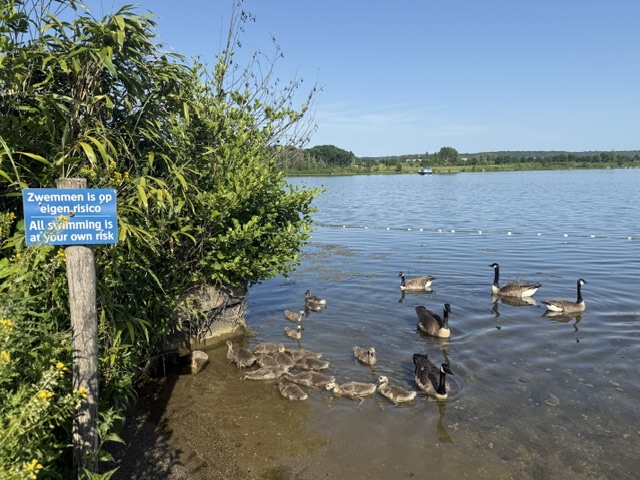
The first time I got infected was last year’s summer in ‘het Zwanenbad’ near Huissen, Gelderland; the second time in ‘de Kralingse Plas’ in Rotterdam. There had been signs warning swimmers about a parasite in the water. Given my history in the tropics I considered myself immune to a local Dutch parasite – my third unwise decision.
Trichobilharzia is the name of the ailment here, better known as ‘swimmer’s itch’. The parasite lives in the intestines of aquatic birds and goes through the same life cycle as in the tropics, with one difference: as soon as the cercariae penetrate the skin, they die and are disposed of by the body. So no problem here, you might think. Except that with every following infection, the immune system responds more aggressively. I only learned this by ‘trial and error’. After the third time I became infected, I ended up completely scratching open the skin on my sides, the creases of my elbows and the back of my knees. The fourth unwise decision was when I went swimming in April, thinking that the cold water would also be too cold for the parasites. Two days later I found myself scratching my skin open, once again.
A lesson for all of you who have spent some time in tropical environments, recently or a long time ago: do not underestimate the parasites in this part of the world! This story ends with a humble note. People who consider that listing health risks separately for ‘tropical countries’ is a form of discrimination, are proven right; at least to some extent.
Adriaan Groen | www.adriaangroen.nl