














































Main content
Power and whose knowledge counts
The appeal of co-creation – as both a paradigm shift in scientific systems and knowledge production as well as a research approach – lies in a simple but powerful promise: that engaging those most affected by health inequalities in decision-making will produce more equitable and effective interventions. In principle, this reflects a shift away from paternalistic models of health improvement towards collaborative problem solving among key stakeholders. In practice, however, translating this promise into meaningful change is considerably more complex.
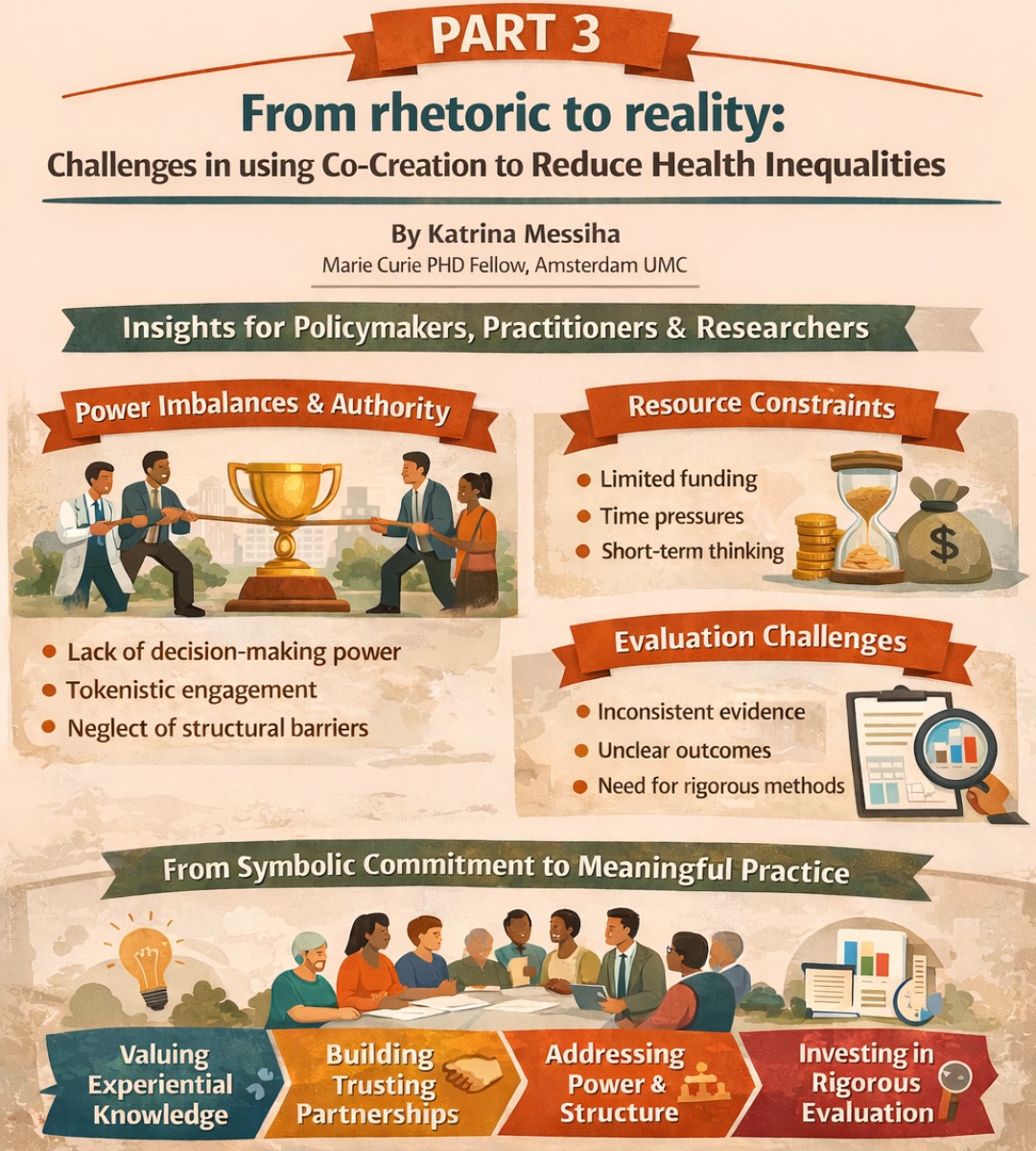
One of the most persistent challenges concerns power. Health systems and research institutions operate within established hierarchies that tend to privilege professional and academic expertise. In such contexts, co-creation aims to broaden whose knowledge informs the design and implementation of initiatives by incorporating the perspectives and experiences of patients, communities and frontline practitioners. However, these institutional structures can still shape how much influence different stakeholders have within collaborative processes. As a result, participation may remain limited if existing decision-
making authority and resource control continue to rest primarily with professional or academic stakeholders.
Co-creation warrants recognising experiential knowledge as equally legitimate to theory-informed and evidence-based knowledge, yet this redistribution of authority is rarely
straightforward. Even when participatory processes are introduced, decision-making power often remains concentrated within institutions, including (local) government. Community
perspectives may influence elements of programme design while fundamental priorities, resource allocation and strategic direction remain unchanged. Without deliberate attention to
power relations, co-creation risks reproducing rather than reducing inequalities.
Looking beneath the surface: context, structure and agency
In my PhD, I have argued in favour of critical realism as a means to offering a useful lens for understanding this tension. [1] Critical realism can be conceived of as a way of thinking
about social problems that recognises that what we observe on the surface is often shaped by deeper underlying forces. [1] In simple terms, it suggests that outcomes – such as health
inequalities – are not caused by a single factor but by interactions between people’s actions, social conditions and institutional structures. In other words, health events/ outcomes do not emerge solely from observable interventions but from deeper social structures and mechanisms, including resource distribution, institutional norms and structural disadvantage.
Co-creation research projects or initiatives that focus primarily on activities without examining these underlying conditions may struggle to achieve lasting impact. Understanding how context, structure and agency (i.e., capacity of individuals or groups to act, make decisions and influence outcomes) interact is therefore arguably essential for meaningful collaboration.
Challenges of rigour and evidence
A second challenge relates to methodological rigour and evidence generation. Despite the rapid growth of co-creation approaches, co-creation as an interdisciplinary field remains
conceptually fragmented. The term itself is often used as an umbrella covering diverse participatory methods without clear operational standards. This lack of coherence limits comparability across studies and weakens the evidence base. Recent work seeking to define the attributes and principles of evidence-based co-creation highlights the need for clear governance, plural sources of evidence, structured yet flexible processes and rigorous evaluation to ensure trustworthiness and impact.[2] Without these foundations, co-creation may risk being perceived as aspirational rather than scientific.[2]
Why time and resources matter
Resources and time also present substantial constraints.[3] Meaningful collaboration requires sustained engagement, trust-building and iterative reflection. These processes rarely align with short funding cycles or institutional pressures for rapid outputs. Tokenistic engagement can undermine trust and reinforce scepticism among communities who have previously experienced exclusion.[4] This kind of engagement refers to situations in which stakeholders or community members are included in a process only superficially, without having meaningful influence over decisions. Participation may take the form of one-off consultations, surveys or meetings where community input is collected but not genuinely considered in shaping outcomes. In practice, when communities perceive that their contributions have little impact, such engagement can undermine trust and reinforce scepticism among groups who have previously experienced exclusion.
The limits of co-creation
Importantly, co-creation alone cannot overcome the structural determinants of health inequalities. [cf. 5] While participatory methodologies/co-creation approaches can improve the relevance and accessibility of interventions, broader drivers of inequality – such as poverty, housing conditions and discrimination – require policy and systemic change beyond
individual programmes. Again, participatory methodologies/co-creation approaches can improve the relevance and accessibility of interventions, but they cannot substitute for broader structural reform. Overstating the potential of co-creation risks placing responsibility for change on communities themselves rather than addressing systemic drivers of inequality.[6] For example, there is a risk that responsibility for improving health outcomes is implicitly shifted onto individuals or communities who already face structural disadvantages. Communities may be expected to solve problems such as low service uptake, poor health behaviours or limited engagement with services, even when these issues are shaped by broader factors such as poverty, housing conditions, discrimination or limited access to care.
What supports successful co-creation
Despite these challenges, there are clear examples where co-creation is successful, for instance in contributing meaningfully to more equitable health initiatives. According to work by Longworth and colleagues [6], leveraging local resources and engaging stakeholders who already have established relationships with the target population can strengthen intervention design and delivery. These stakeholders often possess deeper contextual knowledge and trusted connections within the community. The importance of engaging future or potential implementers early in the process and maintaining close links with stakeholders was also emphasised, as this can increase the likelihood that interventions are successfully delivered and sustained.[6] Finally, nurturing and maintaining stakeholder partnerships is a crucial element of effective co-creation processes.[6]
From symbolic commitment to meaningful practice
For policymakers and practitioners, the key question is therefore not whether co-creation works, but under what conditions it works best. Embedding co-creation within health systems requires organisational change, capacity development and supportive policy environments. It also requires moving beyond rhetoric and treating co-creation as a disciplined methodology rather than a symbolic commitment to participation.[2] Addressing health inequalities appears to demand participatory methodologies/co-creation approaches that acknowledge complexity, context and lived experience. It can be argued that co-creation offers one pathway to integrate complexity, context and lived experience into health initiatives. Its potential, however, will perhaps only be realised through sustained attention to power, structure and methodological rigour.
Read part 1 here
Read part 2 here
References
- Messiha K, Altenburg TM, Schreier M, Longworth GR, Thomas N, Chastin S,
Chinapaw MJ. Enriching the evidence base of co-creation research in public health
with methodological principles of critical realism. Critical Public Health. 2024 Dec
31;34(1):1-9. - Chastin, S. F. M., Smith, N., Agnello, D. M., An, Q., Altenburg, T. M., Balaskas, G.,
de Boer, J., Cardon, G., Chinapaw, M. J. M., Chrifou, R., Dall, P. M., Davis, A.,
Deforche, B., Delfmann, L. R., Giné-Garriga, M., Goh, K., Hunter, S. C., Leask, C. F.,
Lippke, S., Loisel, Q. E. A., Longworth, G. R., McCaffrey, L., Messiha, K., Morejon,
S., Pappa, D., Papadopoulos, H., Ryde, G. C., Sandlund, M., Schreier, M., Steiner,
A., Verloigne, M., Vogelsang, M., & Wadell, K. Principles and attributes of evidence-
based co-creation: From naïve praxis toward a trustworthy methodology-A Health
CASCADE study. Public Health. 2025 Nov 1;248:105922. - Agnello DM, Anand-Kumar V, An Q, de Boer J, Delfmann LR, Longworth GR, Loisel
Q, McCaffrey L, Steiner A, Chastin S. Co-creation methods for public health
research—characteristics, benefits, and challenges: a Health CASCADE scoping
review. BMC Medical Research Methodology. 2025 Mar 6;25(1):60. - Zhang L, Li KT, Wang T, Luo D, Tan RK, Marley G, Tang W, Ramaswamy R, Tucker
JD, Wu D. Co-creation and community engagement in implementation research with
vulnerable populations: a co-creation process in China. Sexual Health. 2024 Dec
5;21(6):SH23149. - Morales-Garzón S, Parker LA, Hernández-Aguado I, González-Moro Tolosana M,
Pastor-Valero M, Chilet-Rosell E. Addressing health disparities through community
participation: a scoping review of co-creation in public health. InHealthcare 2023 Apr
4 (Vol. 11, No. 7, p. 1034). MDPI. - Brandsen T, Steen T, Verschuere B. Co-creation and co-production in public
services: Urgent issues in practice and research. In co-production and co-creation
2018 Mar 15 (pp. 3-8). Routledge. - Longworth GR, Erikowa-Orighoye O, Anieto EM, Agnello DM, Zapata-Restrepo JR,
Masquillier C, Giné-Garriga M. Conducting co-creation for public health in low and
middle-income countries: a systematic review and key informant perspectives on
implementation barriers and facilitators. Globalization and Health. 2024 Jan
17;20(1):9.