







































Main content
When I first began studying approaches in public health research, I was struck by how often co-creation was itself presented as the meta-solution to health inequalities. Co-creation can be defined as an overarching principle for collaboration and innovative problem-solving that engages multiple stakeholders throughout every stage of an initiative, from the initial identification of a problem through to the evaluation of outcomes. [1,2]
The growing policy demand for co-creation
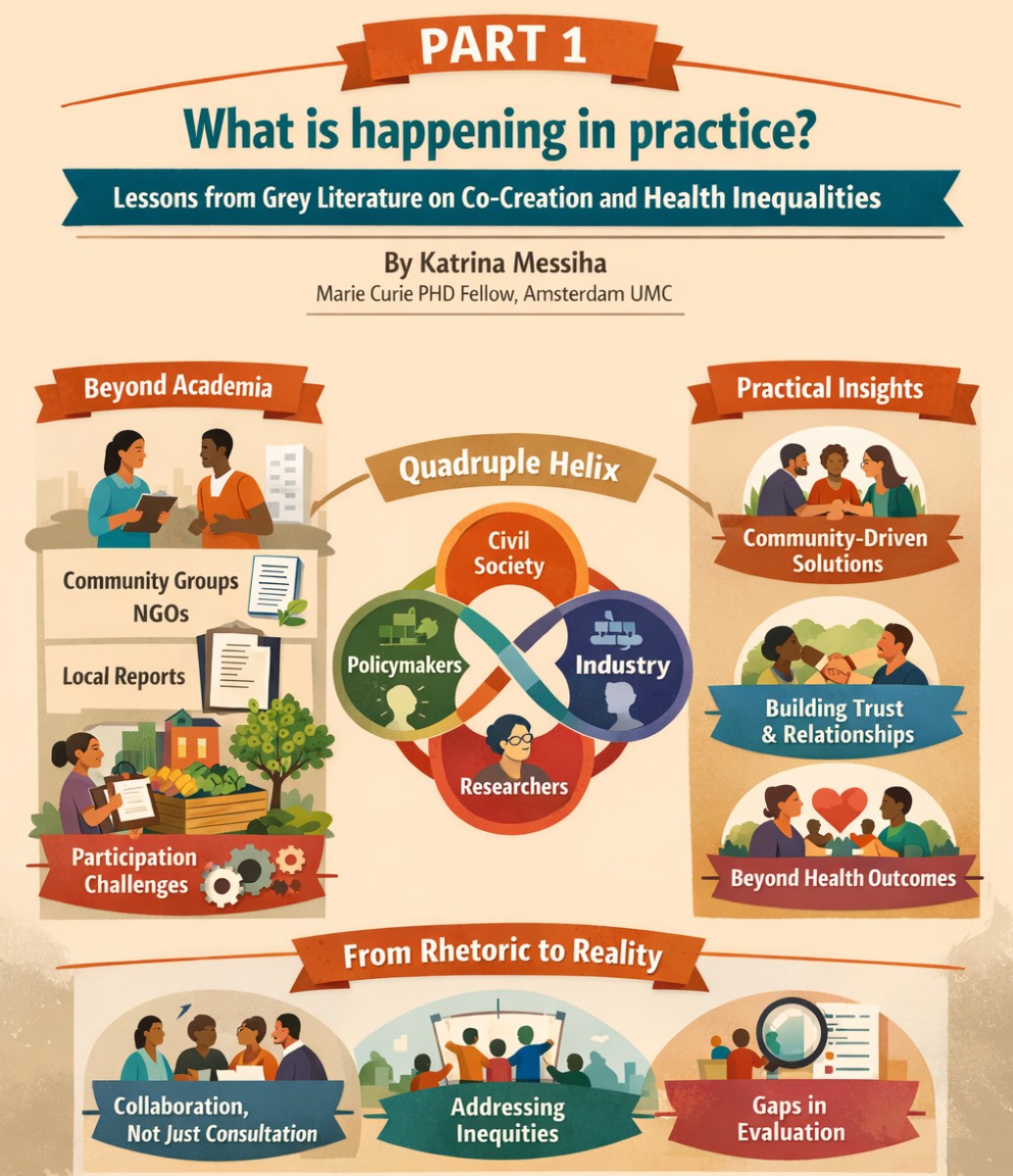
Stakeholders from the ‘quadruple helix’, namely civil society, policymakers, industry and researchers – including funders, increasingly emphasise the importance of regional innovation via co-creation, that is, by working with communities rather than designing interventions for them. [3] This implies the need for collaborative development of solutions engaging multiple societal stakeholders rather than a top-down approach (i.e., a process in which decisions and solutions are designed by authorities or experts and then implemented for others, with limited engagement from those affected). The argument is compelling. If health initiatives are shaped by the experiences and priorities of those most affected by inequities, they are more likely to be relevant, acceptable and sustainable.
Looking beyond academic literature
It is also helpful to briefly consider how co-creation is commonly described in academic publications and why it is important to look beyond these accounts. In the scientific literature, co-creation is often presented through implicit principles, conceptual frameworks and (many) ad hoc methods with some reported outcomes. While such literature can provide value to theoretical grounding, it does not always capture the realities of how co-creation unfolds in practice. The day-to-day dynamics of collaboration, negotiation between stakeholders and the influence of local contexts are often far more complex than what is reflected in published studies. For this reason, gaining a fuller understanding of co-creation requires looking beyond academic publications and also considering how it is experienced and implemented in real-world settings. For instance, many activities in this field are documented in reports produced by charities, community organisations, local authorities and advocacy groups. These forms of grey literature provide a valuable window into real-world implementation, particularly among populations that are often underrepresented in research and routine health data.
What practice-based reports demonstrate
Consolidated evidence from a recent scoping review of grey literature suggests that co-creation initiatives are widely used to engage communities in identifying needs, shaping programmes and adapting services, particularly among disadvantaged groups such as migrant populations, socio-economically marginalised communities and individuals at elevated risk of chronic conditions [4]. These initiatives frequently aim to address barriers to access and engagement by incorporating lived experience into decision-making processes.
Co-creation beyond academia
One notable finding is that co-creation can often occur outside traditional academic environments. Community and third-sector organisations frequently lead initiatives (e.g., many community food programmes and urban gardening projects are initiated by local charities or neighbourhood groups seeking to improve food access and wellbeing), with researchers aiming to serve as collaborators rather than directors. This challenges conventional assumptions about expertise and highlights the importance of experiential knowledge in addressing complex health problems. It also suggests that academic literature may capture only a partial picture of participatory practice.
Many terms, many approaches
At the same time, similar to academic literature, grey literature reveals substantial variation in how co-creation is conceptualised and implemented. [4,5] Terminology ranges from community engagement and participatory research to co-production and human-centred design. Methods differ widely, from one-off consultation exercises to longer-term partnerships embedded within communities. This diversity reflects flexibility and responsiveness to context, but it also creates challenges for evaluation, comparison and synthesis across initiatives.
Distinguishing co-creation from participatory action research
Co-creation is also sometimes conflated with participatory research approaches – and it is useful to attempt to distinguish between these terms. In practice, co-creation often functions as an approach for planning, conducting, evaluating and reporting on interventions, enabling stakeholders and communities to collaboratively design programmes, services or policies. Participatory action research (PAR) is a research methodology in which researchers and participants jointly generate knowledge, often to understand or evaluate interventions in ways that are meaningful to those engaged.
Participation in practice: often limited
Importantly, analysis of participatory methodological processes in the elevated risk of dementia category indicates that many initiatives operate at relatively low levels of stakeholder participation. Stakeholder engagement levels of consultation and involvement are common, while sustained collaboration and shared decision-making are less frequently reported, and examples of full empowerment are rare. [4] Stakeholder engagement often occurs primarily during the implementation phase rather than across the full cycle of planning, evaluation and reporting. This suggests that, although co-creation is increasingly promoted, the extent to which stakeholders are genuinely engaged – and able to influence decisions throughout the process – tends to vary considerably in practice.
Why stakeholder relationships matter
Perhaps the most consistent lesson concerns the importance of relationships in stakeholder engagements. Initiatives that invest time in building trust, working with established community networks and maintaining ongoing engagement report stronger participation and more meaningful outcomes. Conversely, projects constrained by short funding cycles or institutional timelines often struggle to achieve genuine collaboration. The conditions required for effective co-creation therefore extend beyond methodological choice to include organisational culture, resources and time.
Beyond traditional health outcomes
Outcomes described in co-creation reports ought to extend beyond traditional health indicators because co-creation aims to influence a broader set of social and collaborative
processes, not only measurable health outcomes. Improvements in confidence, empowerment, social connection and relationships between communities and services can be meaningful. These improvements are particularly relevant to health inequalities, which are shaped not only by access to care but also by social determinants, trust and institutional responsiveness.
The evaluation gap
Despite growing enthusiasm, robust evaluation appears limited. Many reports focus on describing participatory processes and experiences rather than systematically assessing outcomes, making it difficult to determine effectiveness or cost-effectiveness. This highlights a broader challenge: participatory initiatives are often implemented through co-creation, but their evaluation is not always conducted using equally participatory approaches. This is where PAR may help address this gap by enabling researchers and end users to jointly examine whether interventions work and how they generate meaningful change.
Strengthening evaluation tools and reporting standards therefore remains an important priority. [5]
From rhetoric to practice
The grey literature suggests that co-creation is already widely used in efforts to address health inequalities, but its implementation may vary considerably in depth and quality. The evidence points to a gradual shift away from purely top-down approaches towards more collaborative models, while also revealing persistent gaps between aspiration and practice.
Understanding what is happening in practice is therefore salient. Without examining real-world experiences – including successes, constraints and unintended consequences – it is
difficult to move beyond rhetoric towards more effective and equitable approaches to health improvement. [6]
Read part 2 here
Read part 3 here
References
- Messiha K, Chinapaw MJ, Ket HC, An Q, Anand-Kumar V, Longworth GR, Chastin S,
Altenburg TM. Systematic review of contemporary theories used for co-creation, co-
design and co-production in public health. Journal of Public Health. 2023
Sep;45(3):723-37. - Vargas C, Whelan J, Brimblecombe J, Allender S. Co-creation, co-design, co-
production for public health – a perspective on definitions and distinctions. Public
Health Research and Practice. 2022 Jun 15;32(2):e3222211. - Roman M, Varga H, Cvijanovic V, Reid A. Quadruple Helix models for sustainable
regional innovation: Engaging and facilitating civil society participation. Economies.
2020 Jun 8;8(2):48. - Messiha K, Thomas N, Brayne C, Agnello DM, Delfmann LR, Giné-Garriga M, Lippke
S, Downey J. Grey literature scoping review: a synthesis of the application of
participatory methodologies in underrepresented groups at an elevated risk of
dementia. BMC Medical Research Methodology. 2025 May 3;25(1):122. - Agnello DM, Balaskas G, Steiner A, Chastin S. Methods used in co-creation within
the health CASCADE co-creation database and gray literature: systematic methods
overview. Interactive Journal of Medical Research. 2024 Nov 11;13(1):e59772. - Longworth GR, Erikowa-Orighoye O, Anieto EM, Agnello DM, Zapata-Restrepo JR,
Masquillier C, Giné-Garriga M. Conducting co-creation for public health in low and
middle-income countries: a systematic review and key informant perspectives on
implementation barriers and facilitators. Globalization and Health. 2024 Jan
17;20(1):9.